
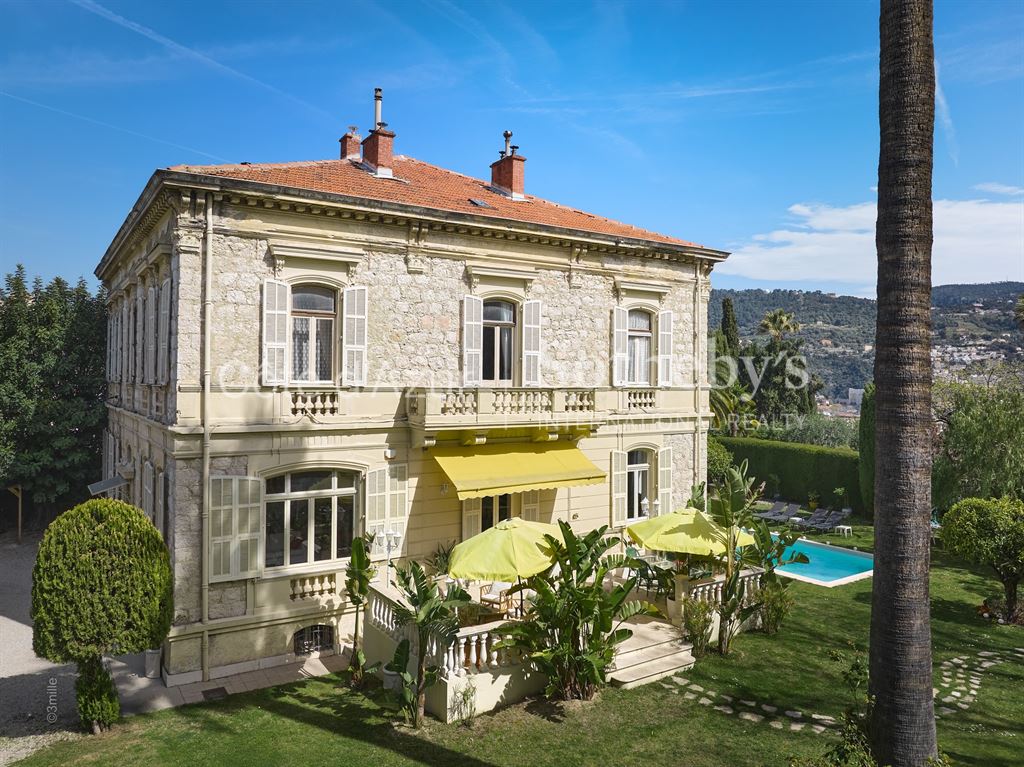
Luxury real estate in Cimiez, Nice
On the hill overlooking Nice, Cimiez encapsulates nearly two thousand years of history—from the Roman city of Cemenelum to the Belle Époque palaces that once hosted Queen Victoria. Few French residential neighborhoods can boast such historical depth concentrated in such a small area.
A hill born from Roman antiquity
Cimiez takes its name from Cemenelum, a Roman city that served for centuries as the administrative center of the region, a prefecture under the Roman Empire, and a rival of Nikaia, the Greek city located on the coast where Old Nice now stands. The remains of this ancient era are still largely visible: the Roman arena, the baths, and the early Christian basilica now form an archaeological site open to the public, right next to the Archaeology Museum. The city declined from the 4th century onwards, its inhabitants gradually migrating to the coast, and the Roman town fell into ruin by the 6th century—a shift that explains why the historic center of Nice is now located on the coast rather than on this strategically important hill.
The Middle Ages and the Franciscan settlement
After centuries of decline, Cimiez experienced a revival in the Middle Ages with the establishment of a Franciscan monastery, whose current church dates from the 16th century. This monastery, still active today, houses three major paintings by the early Niçois painter Louis Bréa and a Baroque altarpiece in carved wood. Its terraced gardens, overlooking the city and the sea, are among the most beautiful green spaces in Nice, and its municipal cemetery is the final resting place of several major artistic figures.
The Belle Époque renaissance and the arrival of European royalty
It was at the end of the 19th century that Cimiez underwent its most spectacular transformation. In the 1880s, land companies began to invest in the hill, buying up farmland to develop prestigious residential projects. The Boulevard de Cimiez, laid out from 1884 onwards at the initiative of Henri Germain, facilitated access to the district and paved the way for the construction of sumptuous luxury hotels.
The most iconic of these remains the Excelsior Regina Palace, built between 1895 and 1897 by the architect Sébastien-Marcel Biasini to accommodate Queen Victoria of England, who had made Nice her preferred winter residence. The building, with its 150-meter-long façade and five stories, boasted all the modern comforts of the time—electricity, central heating, and mains drainage—a remarkable technical feat for 1897. An entire wing was reserved for her, still recognizable today by its dome surmounted by a metal crown created with the collaboration of Gustave Eiffel. The Queen stayed there on several occasions until 1899. Sold as a condominium in 1937, the Regina is now entirely converted into private residences, without having lost its original splendor: sumptuous chandeliers, wrought-iron work, and gardens facing south.
Other palaces followed the same path, such as the Moorish-inspired Alhambra, now also converted into luxury residences. This wave of construction attracted the entire European aristocracy—crowned heads, wealthy entrepreneurs, and renowned artists—who made Cimiez one of the most sought-after winter resorts on the continent.
The district of the great painters
Henri Matisse moved to the Régina in 1938, before returning in 1948 and remaining there until his death in 1953. He is now buried in the cemetery of the Cimiez Monastery. The museum that bears his name occupies the former Villa Gubernatis, a 17th-century residence surrounded by an olive grove, and displays a collection spanning his entire career, from his earliest paintings to the cut-out gouaches of his later years. Further south in the district, the Marc Chagall National Museum, built in the 20th century in a decidedly modern style, presents the artist's biblical message through seventeen monumental paintings, a mosaic, and several stained-glass windows. This concentration of two internationally renowned museums in such a small area is unique on the French Riviera.
A real estate market shaped by this dual history
This historical stratification—Roman, medieval, and then Belle Époque—shapes a unique real estate market unlike any other in Nice. Three main types of properties are found here: luxury apartments in converted former palaces, offering exceptional ceiling heights and preserved period features; residential villas nestled in the hillside gardens, heirs to the Belle Époque urban development; and, more rarely, character properties in the immediate vicinity of the monastery or archaeological site, where heritage constraints are more pronounced but where the charm remains incomparable.
This heritage dimension has a practical downside that should be anticipated: certain buildings or areas of Cimiez may be subject to specific preservation regulations, particularly around the monastery and the archaeological site. Checking these constraints beforehand with the urban planning department of the City of Nice remains a useful precaution before any construction or extension project.
A desirable residential living environment
Despite its rich heritage, Cimiez retains a predominantly residential character. The neighborhood remains peaceful, its airy feel enhanced by gardens and an old olive grove, while still being just minutes from the city center and the Mediterranean via the Boulevard de Cimiez. This rare combination—history, culture, tranquility, and urban proximity—explains why the scarcity of available properties in this area has sustained stable appreciation for decades, driven by buyers who primarily seek a strong sense of heritage, difficult to find elsewhere on the French Riviera.
Discover the Nice market
To explore our listings on the French Riviera, head to our presentation of Provence-Alpes-Côte d'Azur, or our complete search engine.